Folio II · Active Manuscript
In collaboration with Louvre Abu Dhabi · reading across centuries and continents.
About the Manuscript
A long-form reading of a collection built on the premise that art has no geographic boundary.
The Abu Dhabi Manuscript is an eight-chapter long-form reading of the Louvre Abu Dhabi collection — a museum built on a curatorial premise the Codex shares: art has no geographic boundary, and never did. The manuscript is made in the medium Matthew Olivier is the first artist to formally claim — the algorithmic feed itself. Each chapter takes a single painting and reads it across centuries and continents, as a piece of working software in a tradition that pre-dates and post-dates the platforms now competing for the same attention.
Commissioned in collaboration with the Louvre Abu Dhabi, the manuscript follows the museum's signature framing — a Picasso in dialogue with a Mughal miniature, a Manet adjacent to a Bedouin scene. The codex reads these juxtapositions not as multicultural display but as evidence of a shared question: how does an image hold a viewer? Asked in every century, every continent, every medium.
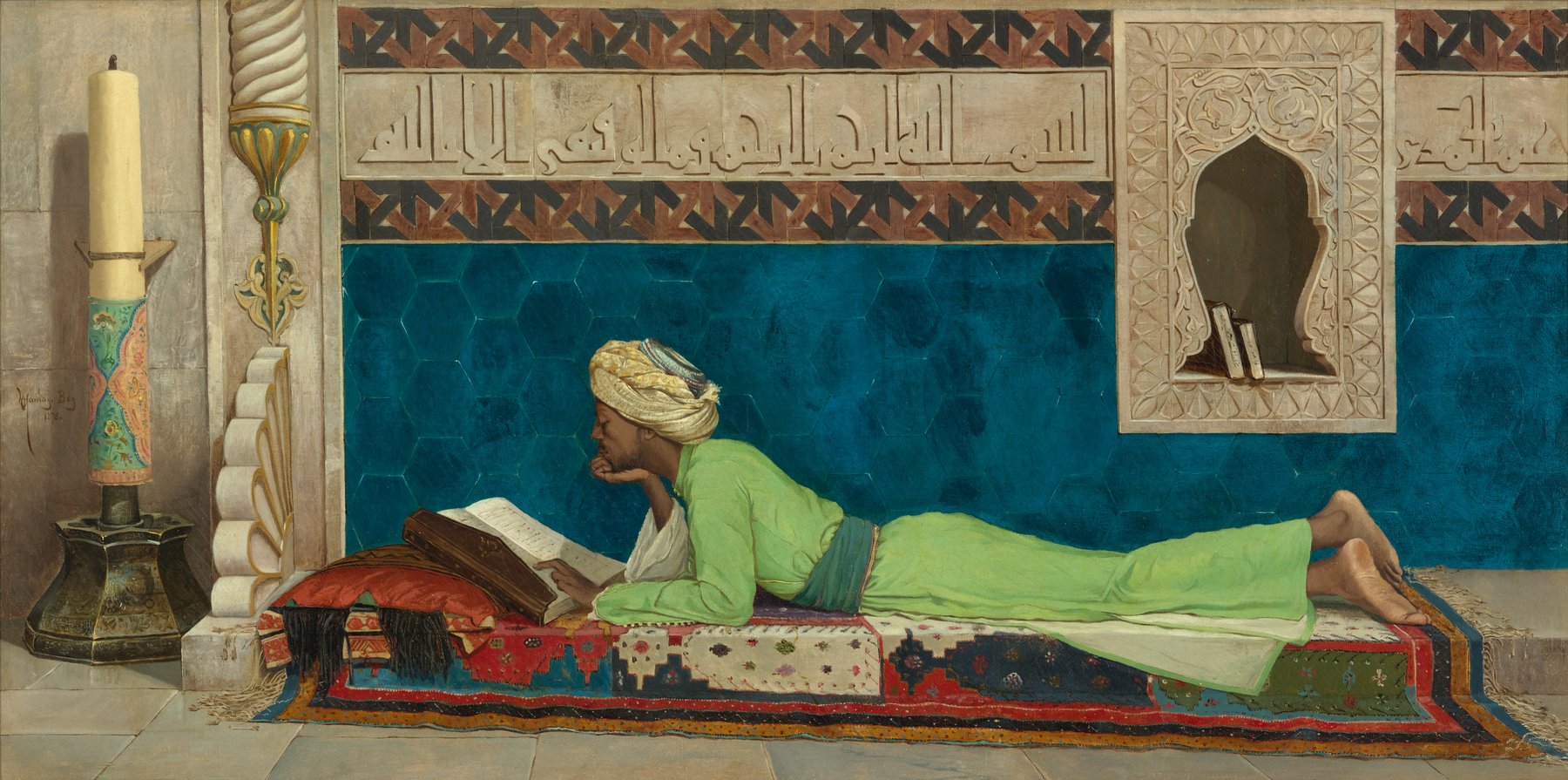
Three chapters are on view; five more are coming soon. The first chapters open with Caillebotte, Floris, and Hamdi Bey; the manuscript will release readings by de La Tour, Ingres, Burne-Jones, and Meynier through the remainder of 2026. All chapters are written; release proceeds on the published schedule.
— Visit —
Louvre Abu Dhabi →I · Selection
Paintings enter the manuscript when they answer a question the present is asking — not in the order they were made or hung. The codex follows the argument.
II · Method
Each chapter reads composition, sightlines, narrative compression, and the management of attention — the same questions modern platforms ask, asked five centuries earlier.
III · Cadence
Roughly one new chapter per month. Each is released as a short video essay with the painter's notes and footnotes. The work is the practice.
Chapter III · Latest Release
Osman Hamdi Bey · c. 1878
Hamdi Bey's young prince at his books — a reading of how the Ottoman painter learned the European gaze and redirected it. A child not as object of orientalist looking but as a reader; his attention turned to the book, locking the viewer in his peripheral vision. The painting teaches its viewer that they are the one being studied.
Watch the essay →Chapters · 3 of 8 bound
Bound chapters open into the full essay. Upcoming chapters are listed by painting; click "Notify me" to subscribe to release alerts.
Subscribe to the Manuscript
Subscribers receive each chapter of The Abu Dhabi Manuscript as it binds — along with chapters from the other manuscripts, codex announcements, and studio news.
Sent as chapters bind · No marketing · Unsubscribe anytime
About
Codex Algorithm is the major conceptual artwork of Matthew Olivier — visual artist and conceptual artist, with major practices in painting and writing. The work is a long-form sequence of algorithmic essays — short films and writings — that read paintings from across the historical record as early instances of the attention-engineering we now call the algorithmic feed. All essays are written by the artist; the narrator's voice is rendered through synthesis as a deliberate mask, in keeping with the work's argument that the medium is the message. The work treats the algorithmic feed itself as both venue and medium. The Abu Dhabi Manuscript extends that reading across centuries and continents.
Enter the Codex →